

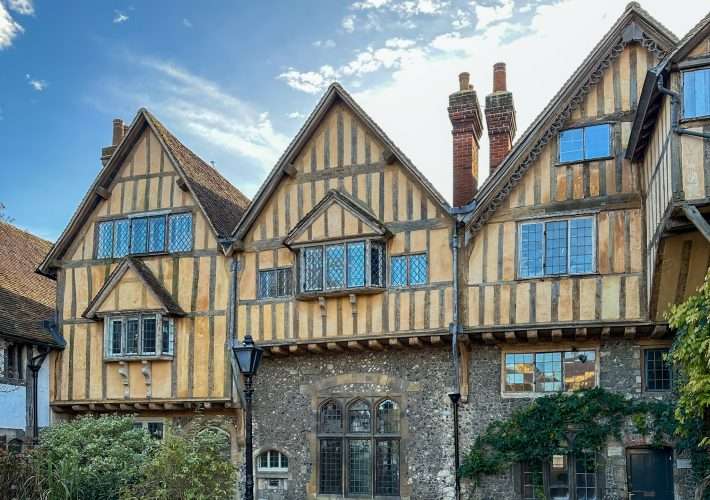
If you’re looking for a historic English town with medieval streets and timber-framed buildings, Shrewsbury is well worth considering. But there’s more to Shrewsbury than its pretty streets.
The town also has connections to some fascinating characters and events, as well as a few wonderfully quirky things to discover along the way.
In this post, I’ll take you through 12 of the best things to do in Shrewsbury, from exploring its historic buildings and churches to discovering some of its more unusual sights. I’ll also cover how long you need to visit, where to stay, places to eat and drink, and how to get there.
Whether you’re planning a day trip or a longer stay, this post has the information you need to start planning your visit to Shrewsbury.
Where is Shrewsbury?
The historic town of Shrewsbury is encircled on three sides by a loop of the River Severn in the English county of Shropshire. The town is about 14 kilometres east of the England-Wales border and about 240 kilometres, as the crow flies, northwest of London.
Is Shrewsbury Worth Visiting?
Definitely! Shrewsbury has medieval charm, fascinating history, green spaces and a riverside location, all of which combine to make it a lovely town to explore. With its half-timbered buildings, winding streets and wealth of interesting sights, there’s plenty to discover.
How Many Days Do You Need in Shrewsbury?
I spent two nights in Shrewsbury, which gave me around a day and a half to explore the town. This was enough time for me to experience all 12 activities included in this post, as well as stop for coffee and take time to explore some of Shrewsbury’s shops.
If you’re short on time, you could see many of Shrewsbury’s highlights in a day. However, I’d recommend staying overnight if you can, particularly if you’re travelling by train. Depending on where you’re travelling from, you may need to change trains to reach Shrewsbury, which can make the journey longer and reduce the time you have available to explore. Staying overnight gives you more time to see the sights without rushing, as well as the opportunity to enjoy some of the town’s smaller streets, stop for a coffee or meal and simply take in the atmosphere.
A Bit of Shrewsbury’s History
Although Shrewsbury can trace its earliest origins back to prehistoric times, it was during the Saxon and medieval periods that the town began to develop into the historic town you can explore today. Here are some of the key milestones in Shrewsbury’s history:
- c.900: A Saxon settlement developed at Shrewsbury, which became known as an important town in the region
- 1070: Shrewsbury Castle was built following the Norman Conquest as part of the effort to control the Welsh border
- 1150: The town became an important centre for the wool trade, helping Shrewsbury prosper during the medieval period
- 1552: Shrewsbury School was founded by King Edward VI. The school’s original buildings later became the town’s public library
- 1642: King Charles I stayed at the Council House during the English Civil War, when Shrewsbury was an important Royalist centre
- 1809: Charles Darwin was born in Shrewsbury
- 1848: The railway arrived in Shrewsbury, connecting the town with other parts of the country and contributing to its development as an important railway town
Today, Shrewsbury retains much of its historic character, with medieval streets, timber-framed buildings, historic churches and other surviving landmarks making its long history easy to discover.


12 of the Best Things to Do in Shrewsbury
These are 12 things I experienced during my time in Shrewsbury and recommend adding to your itinerary:
1. Explore the Historic Town
Shrewsbury is known for its medieval buildings and street layout making it a fascinating place to just wander. There are plenty of half-timbered buildings to admire and small, narrow passages to explore.
The town centre is also quite lively with plenty of shops, restaurants and cafes more than happy to welcome visitors!


2. Visit the Castle Gates Library and Charles Darwin Statue
Shrewsbury library is located in what was Shrewsbury School. The original school was founded by King Edward VI in 1552. Additional stone buildings were added between 1594 and 1630. The school operated on site until 1882 when the premises were converted to a public library which opened in 1885.
Charles Darwin and Judge Jeffreys (his reputation for severity resulted in his nickname, the Hanging Judge) were two of the school’s most well-known students. There’s an impressive statue of Darwin outside the entrance which you can’t miss.
It’s definitely worth popping into the library and heading upstairs to the Darwin Room for views of the impressive ceilings where you’ll see the various coats of arms of the original school Trustees on display. Carry on into the Old School Room to see graffiti, left by former pupils, carved in the wood panelling.


3. Take a Peek at the Council House Gatehouse and Gateway
Located a short walk from the library are the Council House Gatehouse and Gateway which lead through into the courtyard of the old Council House. The Council House was once the Shrewsbury headquarters of the Council of the Marches, the entity that governed and administered justice in Wales and the border counties of England.
The Gatehouse and Gateway date from around 1620. The Council House is thought to date from the early 16th century. Both are located in the outer bailey of Shrewsbury Castle.
A blue plaque on the gate confirms that King Charles I stayed at the Council House in 1642 as did his son James II in 1687.


4. Wander through the Old Market Hall
In the centre of Shrewsbury you’ll find the Old Market Hall. Although an earlier market hall existed here from the 1260s, the Old Market Hall seen today was built in 1596 and reflected Shrewsbury’s prosperity and importance as a trading centre.
I was interested to learn that there was once a pool or bog in front of the Old Market Hall where nagging wives and dishonest traders were tied to a stool and ducked into water!
Today, the Old Market Hall houses a cafe and cinema. You can read an interesting summary of its history on the official Old Market Hall website. Don’t forget to take a look on the back of the Old Market Hall at the sun dial.
Close by you’ll also find the Shrewsbury Museum and Art Gallery which is free to visit but closed Sundays and Mondays.
5. See the Bellstone
You might think that looking at a stone is a rather unusual thing to have on a list of the best things to do in Shrewsbury, but this is no ordinary stone!
The Bellstone is a granite boulder and was Charles Darwin’s first introduction to geology. As a child, he was told that this kind of stone only existed further north in Cumbria and Scotland and that no one could explain how it had arrived in Shrewsbury. When he was studying geology in Edinburgh however, he learned that during the last ice age, glaciers moved rocks such as this and deposited them across the country. This interest in geology ultimately saw Darwin join HMS Beagle on its five-year-long survey expedition.
The Bellstone is located in Morris Hall Courtyard.


6. Visit St Chad’s Churchyard
The distinctive round shape and tall tower of St Chad’s Church are both worth seeing but if you enjoy things that are a little unusual, make your way into the adjoining graveyard.
The graveyard is no longer used and was a little overgrown when I visited, but it’s here you’ll find the ‘grave’ of Ebenezer Scrooge!
The grave was created for the 1984 version of the movie, A Christmas Carol. Apparently, the headstone is a period headstone whose original inscription had worn off. The film production crew asked the Church if they could use the headstone and subsequently inscribed “Ebenezer Scrooge” on it.
It’s a quirky thing to see and I wasn’t alone in visiting it!
St Chad’s Church is thought to have been founded in Saxon times, although only at its current location since 1792. Charles Darwin was baptised here in 1809 and attended the Church as a child.


7. Wander along Grope Lane
Shrewsbury’s medieval street layout means that there are plenty of small passageways to explore. One of those is Grope Lane.
Although it’s not a particularly exciting lane in terms of shops etc, it probably was at one time! As was usual in medieval times, streets were often named after the activities carried on in them and in the case of Grope Lane, it is believed to be a reference to prostitution!
8. Climb The Bear Steps
The Bear Steps is an area encompassing not just some historic steps, but an art gallery and medieval hall, cafe and two of Shrewsbury’s five churches, St Alkmund’s and St Julian’s. St Alkmund’s Church was founded in 912 and is actually the highest point in Shrewsbury.
The name ‘Bear Steps’ has its origins with the Bear Steps Inn that once stood on the corner of Fish Street and Grope Lane. Local legend suggests that the Inn may have gained that name because it kept a bear captive and made it dance for the public. Another legend suggests that there may have been a medieval bear pit in the area.
Whatever the origins of the name, make sure you stop by!


9. Explore the Grounds of Shrewsbury Castle
Shrewsbury Castle is a large red sandstone castle which dates from 1070 and sits above Shrewsbury railway station.
The Castle has undergone extensive repairs over the years and today it houses the Soldiers of Shropshire Museum featuring collections from the King’s Shropshire Light Infantry and Shropshire Yeomanry. There is a fee to enter and opening hours are seasonal so do check the official Shrewsbury Castle website for up-to-date visitor information. I did not visit the museum but chose to spend time in the gardens instead.
The Castle gardens are free to enter and are a lovely colourful space in which to relax. Climb the stairs in the garden up to the octagonal Laura’s Tower, a small red sandstone folly built around 1790 on the Castle motte as a summer house for the daughter of the Castle’s then owner, Sir William Pulteney. There are great views over the surrounding countryside from this point.


10. Visit Shrewsbury Prison
Not every trip has to involve time in jail but this one should!
Shrewsbury Prison dates from 1793, although the prison open to visitors today was rebuilt in 1877. For many years, the prison was a place of execution, with the final execution having taken place in 1961. Both men and women were imprisoned here until 1922 when female prisoners were moved out and it became a male-only prison.
The prison was decommissioned in 2013 and operates today as a dark history tourist attraction. You can choose from guided or self-guided tours, evening ghost tours, escape room experiences or, if you’re brave enough, staying overnight!
I explored on a self-guided tour and found it to be a very educational experience and one I definitely recommend. Check the official Shrewsbury Prison website for details of what’s on and up-to-date ticket prices.


11. Stop by St. Mary’s Church
St. Mary’s Church is a redundant church dating from the 12th century. It’s the largest church in Shrewsbury and houses some lovely stained glass. The volunteers at St. Mary’s are also very helpful and the information available to visitors is excellent.
Don’t miss the plaque on the church tower in memory of Robert Cadman, a young 18th-century steeplejack and rope slider who, in acts of daring, would slide or fly along a rope between St. Mary’s and a meadow across the River Severn. Unfortunately, in 1739 he fell to his death when his rope broke.


12. Relax in The Dingle
Across the road from St Chad’s Church is the 29-acre Quarry Park which dates from 1719.
At the heart of the park is the beautiful Dingle Garden, a sunken garden containing various flower gardens, grassed areas, rockeries and water features. It’s a beautiful space and I definitely recommend heading there at some point during your visit to Shrewsbury.
The Dingle Garden is open Monday to Sunday, 8.30am to 5.30pm and is free to visit. It is locked and unlocked each day though.
The Quarry Park is open 24 hours and is home to a fitness and swimming centre, bandstand, extensive parkland, war memorial, a riverside walk and other similar attractions.


Recommended Cafes in Shrewsbury
Sightseeing and exploring can be tiring but thankfully Shrewsbury has a great range of cafes where you can take a break. Here are three spots I visited and am happy to recommend:
1. The Riverview Cafe: located inside an old hospital alongside a variety of other shops, the cafe has an outside terrace with lovely views over the River Severn. The menu offers a wide variety of breakfast and lunch items, including vegan and gluten-free options. I enjoyed a lovely Shropshire blue cheese and chutney sandwich with a great-tasting cappuccino.
2. The Cats Pyjamas: located next to the Old Market Hall, you can grab brunch (including vegetarian, vegan and gluten-free options) and coffee (in my case a lovely red berry & rose latte) here.
3. The Shrewsbury Coffee House: conveniently located across from the railway station, the coffee was great and the cafe itself bright and welcoming. They also serve a good range of food.
There are plenty of other cafe options throughout Shrewsbury, including inside the prison! You’ll also find plenty of restaurants around town, from well-known chains to independent spots as well as pubs, supermarkets and bakeries. I’m fairly confident that you won’t go hungry!


Where to Stay in Shrewsbury
There are a range of accommodation options available in Shrewsbury. I stayed at The Alb which is conveniently located not far from the railway station. If you are driving to Shrewsbury, then there are various options outside of the town centre which also include parking.
How to Get to Shrewsbury
Visitors to Shrewsbury can arrive by train, car or bus.
1. By Train
Trains running from London to Shrewsbury typically involve changing at Birmingham New Street. Direct services are available from nearby major hubs such as Birmingham, Manchester and Chester.
The train station is located in the centre of town, making it easy to get to nearby accommodation or to start exploring as soon as you arrive!
If you’re planning to get to Shrewsbury by train, I recommend reviewing current timetables and booking in advance.
2. By Bus
Long distance and regional buses both arrive into Shrewsbury. Although bus tickets may be cheaper than train tickets, travel times will be longer and therefore impact on the time you have in Shrewsbury. If you are planning to travel by bus however, do check routes and prices here.
The bus station is also conveniently located in the centre of Shrewsbury.
3. By Car
Shrewsbury is easy to reach using major roads and you can plan your route using the AA Route Planner. If you do travel by car, then check the Shropshire Council website for car parking and park and ride options.
Final Thoughts
Shrewsbury turned out to be a great little town to explore. I enjoyed the combination of medieval streets, historic buildings and green spaces, but it was the unusual details and unexpected discoveries that made the visit particularly memorable. From the mysterious Bellstone and the grave of Ebenezer Scrooge to the beautiful Dingle Garden, there was plenty to surprise me.
I spent two nights in Shrewsbury and around a day and a half exploring. This gave me enough time to experience all 12 things included in this post without rushing. I recommend considering an overnight stay rather than trying to squeeze everything into a day, particularly if you’re travelling by train and your journey involves a change.
If you’re planning to explore more of the United Kingdom, don’t forget to stop by my collection of United Kingdom posts for more destination ideas. And if you’re ready to start planning your next trip, you’ll find the travel companies and services I use and recommend on my Resources page.

Disclaimer – Information correct at the time of writing but do check before visiting.


Leave a Comment