

Last updated on June 16th, 2026 at 09:13 am
The beautiful city of Cambridge England is a perfect destination for day trippers. Its small size belies its huge contribution to world history whilst its old streets, green spaces and location on the banks of the River Cam paint a picture that is quintessentially English.
Easily accessible from London, Cambridge offer visitors plenty to see and do, even in just one day. I have visited twice now, most recently this month, and would very happily return.
In this post I’ll set out all you need to know to make a day trip to Cambridge. I’ll share details of how to get there and what to include in your Cambridge day trip itinerary. I’ll also give you a bit of an historical overview, a general travel guide and some travel tips so you too can get the most out of one day in Cambridge.
Is A Day Trip To Cambridge Worth It?
Absolutely! Cambridge is a small, very walkable city with history around every corner. A world famous university, beautiful architecture and a busy city centre make it a perfect day trip destination.
It goes without saying that the longer you stay in a destination, the more you will be able to see and do. Spending a day in Cambridge however will definitely give you the opportunity to see and experience much of what the city has to offer.
How To Get To Cambridge From London
The city of Cambridge is located on the River Cam in the English county of Cambridgeshire about 90 kilometres (about 55 miles) from London.
To get to Cambridge, you have the following options:
1. Train
The quickest way to get to Cambridge from London is by train. Trains depart from 2 stations – London Kings Cross and London Liverpool Street. The fastest trains are generally from King Cross and have a journey time of around an hour. I travelled from Liverpool Street station on a direct train and the trip took a little over 1 hour and 20 minutes.
I would recommend visiting Cambridge by train. Leaving early/mid morning and returning home late afternoon/early evening will give you enough time to explore the city and see much of what it has to offer.
Note: there are two train stations in Cambridge. The main station is Cambridge (CBG) and is about one mile from the city centre. The other station is Cambridge North (CMB) which is about 2 miles from the city centre. Most visitors will arrive, as I did, into Cambridge.
You can search availability and book train tickets here:
Getting from the train station to the city centre is straightforward. Your options are:
- walking – it will take around 17 minutes
- catching a bus – the bus stop is to your left as you exit the station (look for routes 1, 3 and 7)
- taking a taxi – the taxi rank is to your right as you exit the station
2. Coach
Bus services from London to Cambridge are also available. Whilst tickets are likely to be cheaper, travel times may be slightly longer which will, of course, eat into your time in Cambridge. This won’t be an issue if you plan to stay overnight, however for day trippers like me, time is of the essence!
You can check all available bus options and book on Busbud. Do note though that the bus stop may be at the Trumpington Park and Ride. You will therefore need to travel from there into the city centre.
3. Car
If you prefer travelling to Cambridge by car, then do check the AA Route Planner. There are various car parking options in Cambridge – do check the Cambridge City Council website for up to date information.
A (Very) Short History Of Cambridge
I’m not a historian but I always think it enhances a trip to know a bit about your destination. In the case of Cambridge, I’ve summarised some key dates/time periods below:
- Around 70 AD – Romans build a fort on Castle Hill (Note – there is evidence of settlement since prehistoric times and during the Iron Age)
- Late 5th century – Anglo Saxons arrive
- 875 – Vikings arrive
- 1068 – William the Conqueror erects a castle on Castle Hill
- 1209 – scholars arrive from Oxford and establish the University of Cambridge
- 1275 – expulsion of the Jews
- 1284 – Peterhouse College is founded
- 1326 – Clare College founded. Between 1326 and 1977, more colleges were founded (either new ones or as the result of merging some existing) bringing the total number of Cambridge colleges today to 31
- 1349 – the Black Death arrives
- 1534 – Cambridge University Press is founded
- 1640 – Oliver Cromwell elected Member of Parliament for Cambridge
- 1829 – the boat race rowed against Oxford takes place
- 1948 – first women admitted to study for full academic degrees
- 1951 – Cambridge is granted its city charter (i.e. city status)
This is a very high level summary and not all events are listed. Instead, I wanted to give a sense of the long history Cambridge has. You can also learn more about Cambridge in this Wikipedia article and by visiting some of the sites I mention below.
What Is Cambridge Known For?
Cambridge is best known for its University, the 3rd oldest in the world in continuous operation.
As I mentioned above, the University was founded in 1209 when scholars from the University of Oxford left and settled in Cambridge following a dispute with the Oxford townspeople. Today, there are 31 Colleges which together comprise the University of Cambridge. You can learn more about the individual Colleges on their websites.
As you would expect, there are many notable Cambridge alumni. Included amongst them are Charles Darwin and Isaac Newton.

10 Things To Do On A Day Trip To Cambridge
To help you plan your own itinerary, here are 10 of the best things to do during a day trip to Cambridge:
1. Discover the History of Cambridge at the Round Church
Location: Bridge Street
The Round Church (also known as the Church of the Holy Sepulchre) is a great place to start a day in Cambridge.
The church was founded between 1114 and 1131 and was built to resemble the Church of the Holy Sepulchre in Jerusalem. The tower was built in the 1400s but collapsed in 1841. In 1644, during the English Civil War, a Parliamentarian destroyed 14 of the windows.
Extensive renovations have been carried out with the result that today there is a mix of time periods reflected in the columns and arches, tiles, stained glass windows and decorative elements.
Today, the Church hosts the Cambridge Story exhibition. The exhibition sets out the history of Cambridge from Roman times through to today on 12 easy to read panels. The development of Cambridge is set in the context of other world events with a focus on the influence of Christianity. There is also a 23 minute film visitors can watch.
It’s a very good exhibition and I highly recommend visiting. The key things to note are:
- tickets to enter the church cost £3.50
- the visitor centre opens at 10am and closes at 5pm daily except for Tuesday when it opens at 1.30pm and closes at 4pm. Closed on Sundays
- guided walking tours of Cambridge are available at 2.15pm on Wednesdays to Saturdays (inclusive) at 2.15pm. Tickets cost £14
Do check the official Round Church website for up to date visitor information and to book a walking tour.


2. Climb the Tower of Great St Mary’s Church
Location: Senate House Hill (north end of King’s Parade)
Great St Mary’s Church has played an important role in Cambridge since the early 1200s when it was the first home for the University and the scholars who arrived in 1209. The current church dates from 1478-1519.
The tower, which is almost 35 metres (114 feet) tall, was finished in 1608. Today, visitors who climb to the top of the tower are rewarded with amazing views over Cambridge. Be warned though…the narrow spiral staircase contains 123 steps! There are a couple of small places to stop on the way up and down, including beside the bells. Four of the bells were installed in 1515 and the rest in the 17th century.
I definitely recommend visiting the church and climbing the tower. Here’s a few key points to note:
- entrance into the church is free
- tickets to climb the tower cost £7.50
- the ticket to the tower gives visitors a 10% discount on teas, coffees and lunches at the nearby Michaelhouse Café – I’ve been here twice now and it’s very good


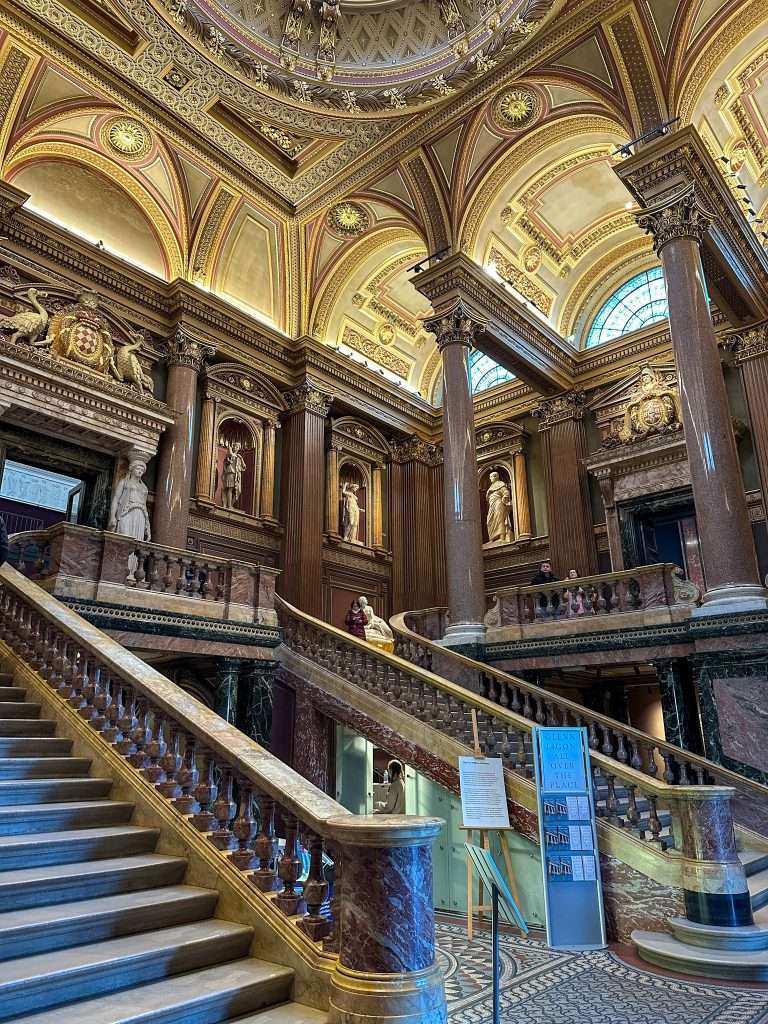
3. Visit the Fitzwilliam Museum
Location: Trumpington Street
I highly recommend including a visit to the Fitzwilliam Museum in your Cambridge itinerary.
Set across two floors, the museum has a wonderful collection of artifacts from the ancient world (think Egypt, Greece, Rome), beautiful works of art, ceramics and much more. There is also a large shop and cafe.
As a day tripper, you will have to pack in as much as you can so I would suggest working out beforehand what you want to see and spending an hour at the museum. I focused on seeing the exhibits from the ancient world and some art work in that time. To see more of the museum, I would think 2-3 hours would be required.
The museum is free to visit and has the following opening hours:
- Tuesday-Saturday: 10am – 5pm
- Sundays and Bank Holidays: 12 – 5 pm
Check the official Fitzwilliam Museum website to help plan your visit.


4. See the Mathematical Bridge
Location: Queens’ College
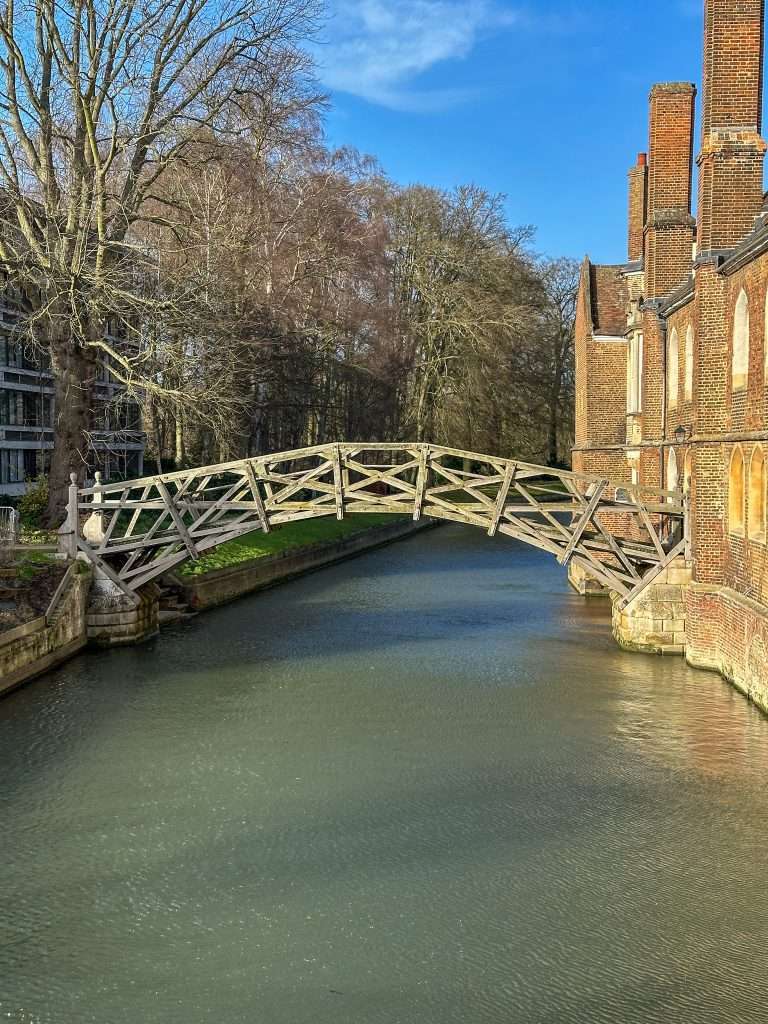
The Mathematical Bridge is a wooden footbridge which spans the River Cam and connects two parts of Queens’ College. First built in 1749, it was repaired in 1866 and rebuilt to the same design in 1905. It is almost 15.5 metres (just over 50 feet) long and although it looks like an arch, its actually made of straight pieces of wood.
I have read conflicting information about accessing the bridge. Some sites state that you can only cross the bridge if you are a student or staff of the University whilst others have stated that you can access it from the Porters Lodge for a fee of £3.50 (although this may now be £5).
It seemed to be students only who crossed the bridge during my visit but I did not enquire of the Porters Lodge so cannot confirm either way. What I can confirm however is that there is a great view of the bridge from the Silver Street Bridge. Alternatively, you will get up close to the Mathematical Bridge if you go punting on the River Cam.
There are a several myths surrounding the bridge including:
- the myth that Isaac Newton designed the bridge – he did not. In fact, he died before it was built and there are no records indicating he was ever involved
- the myth that the bridge was first built without fastening at the joints – not true, the structure needed fastening from the very start

5. Visit St. Bene’t’s Church
Location: Bene’t Street
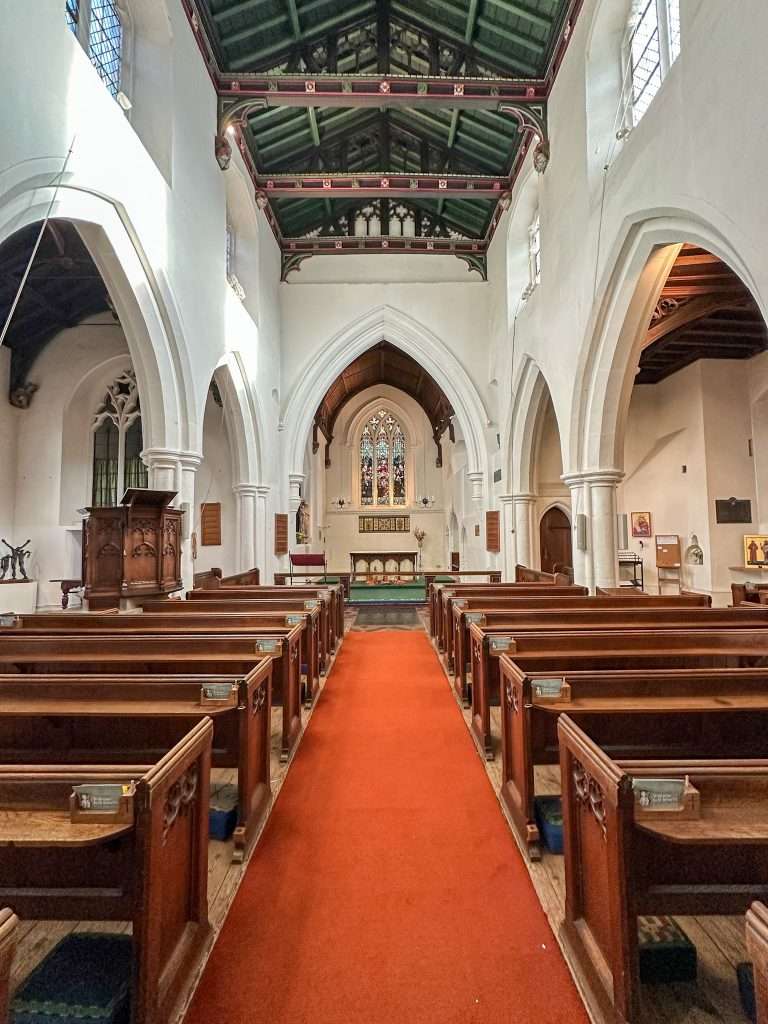
This small church has been a place of worship for 1,000 years. It is thought that the church dates from around 1020, although since that time it has undergone various remodelling and building changes.
In a city of old buildings, St. Bene’t’s Church is the oldest and definitely worth visiting. It’s free to enter, although donations are welcome, and you can pick up a small guide which explains some of the history of the church and many of its features.


6. Have Lunch at The Eagle Pub
Location: Bene’t Street
Across the road from St Bene’t’s Church is one of the oldest inns in Cambridge, The Eagle.
It dates back to 1667, although information inside says that there was a tavern on the site back in 1353. The Eagle is well known as the place where Francis Crick, in 1953, announced that he and James Watson had discovered the structure of DNA.
I decided to have lunch there and wasn’t disappointed. A good selection of food in an historic setting made it a perfect place to stop. The Eagle is open from 12 noon.


7. See the Corpus Clock
Location: Trumpington Street (at the junction with Bene’t Street)
The Corpus Clock is a rather unusual looking clock located at street level outside Corpus Christi College. Its face is gold plated stainless steel, there are no numbers or hands and time is indicated by the appearance of blue LED lights in slits in the clock face.
The strangest part however is the presence of a large grasshopper like insect at the top. The grasshopper contains the clock’s escapement, the mechanism which checks and releases a clock’s train gear in order to advance the hands. The grasshopper, including its mouth, moves and in so doing its message is one of time moving. An inscription beneath the clock reinforces this.
The clock was designed by Dr. John Taylor, an alumnus of Corpus Christi College and unveiled to the public by Stephen Hawking in September 2008.

8. Visit King’s College Chapel
Location: King’s Parade
Let me start by saying that I was given incorrect information by those at the gates to the College during my day trip to Cambridge and as a result, when I went to buy my ticket to visit the Chapel I was told it was closed for the day!
The external view of of King’s College and in particular the Chapel are wonderful so it was disappointing not to get inside.
King’s College was founded in 1441 by King Henry VI, although the building of the Chapel did not begin until 1446. Finished in 1544, it’s home to the worlds largest fan vaulted ceiling.
Given my experience, I would highly recommend you either order your ticket online in advance on the official King’s College website or purchase it in person at the King’s College Visitor Centre on King’s Parade as soon as you arrive in Cambridge. In busy times, I recommend booking online in advance.
Online adult tickets are priced as follows (concessions available):
- Monday – Friday: £17; early bird booked in advance £16
- Weekends: £18; early bird booked in advance £16.75


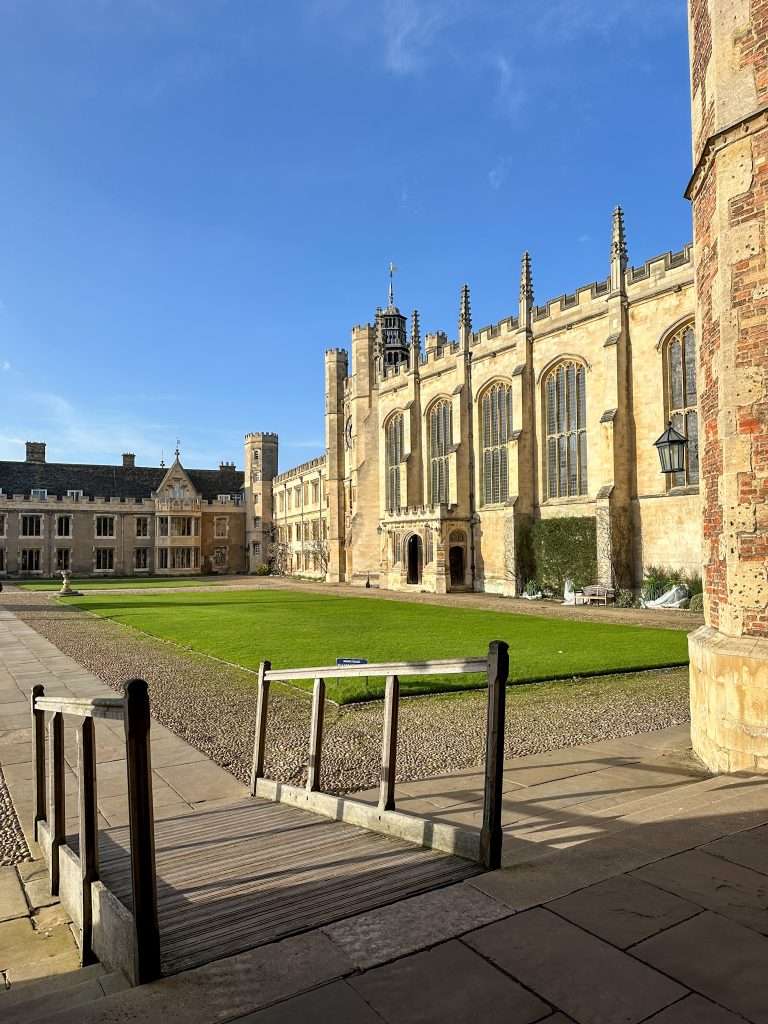
9. Stop by Trinity College
Location: Trinity Street
I have visited Trinity College on a previous visit to Cambridge and stopped by again during my recent day trip. Unfortunately, the College was not open to visitors on this occasion, however it is possible to view the Great Court from the Porters Lodge.
One of the most popular sights to see at Trinity however is the Isaac Newton apple tree. You do not need to enter the College to see this – it can be viewed from the street. The apple tree is a cutting from the tree located at Newton’s childhood home from which he saw the apple fall, thus beginning the development of his theory of gravity.
The apple tree in Cambridge is located beneath the windows of the room Newton occupied at Trinity College.

Another part of Trinity College I recommend visiting if you can is the Wren Library. It does have limited opening times but the impressive interior makes a visit worthwhile. Check the official Trinity College website for up to date information regarding the library and College access times generally.
10. Walk along The Backs
The Cambridge Backs (or the Backs for short) is a large landscaped open green space located alongside the River Cam and behind several Colleges, including Queens’, King’s, Clare, Trinity and St. John’s.
Whilst access into the Colleges isn’t possible, I enjoyed the walk along the path between Silver Street and Garret Hostel Lane.
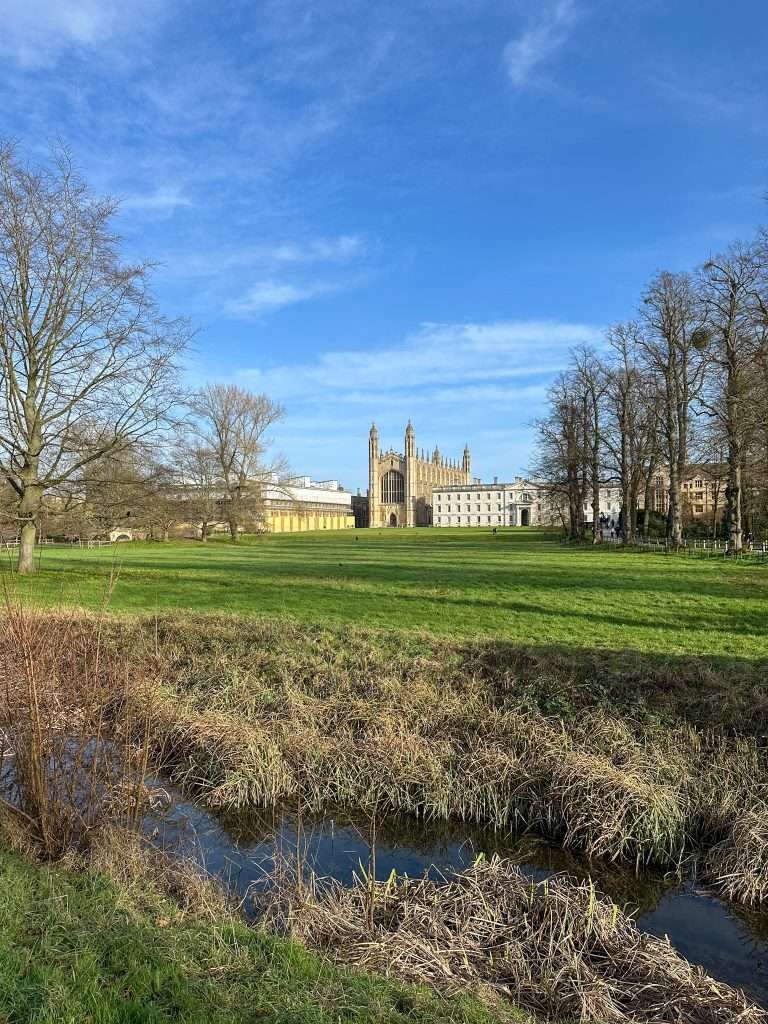
The best way to view the Backs however is to join a punting tour along the River. There are various options to chose from – you can research availability and book here:
Further Ways To Spend A Day In Cambridge
If you are looking for some alternative things to do in Cambridge then you may want to consider including the following options in your one day itinerary:
- join a hop on hop off bus tour
- go shopping! The city centre is home to many well known shops and businesses
- join a walking tour
There is certainly plenty to keep a day tripper busy in Cambridge!
Final Thoughts
The historic city of Cambridge is easily accessible from London and an excellent choice for a day trip. The 31 Colleges that make up the world famous Cambridge University along with the ancient streets, Cam River, historic churches and modern shopping opportunities mean that visitors to Cambridge have plenty to see and do.
I hope this post has convinced you to visit and that my suggestions of what to do there will aid you in creating your own day trip Cambridge itinerary.
If you need more assistance in planning your day trip to Cambridge, then do check my Resources page. If you’re looking for other UK day trips, then do check the posts on my United Kingdom page.

Disclaimer – Information correct at the time of writing but do check before visiting.


Leave a Comment